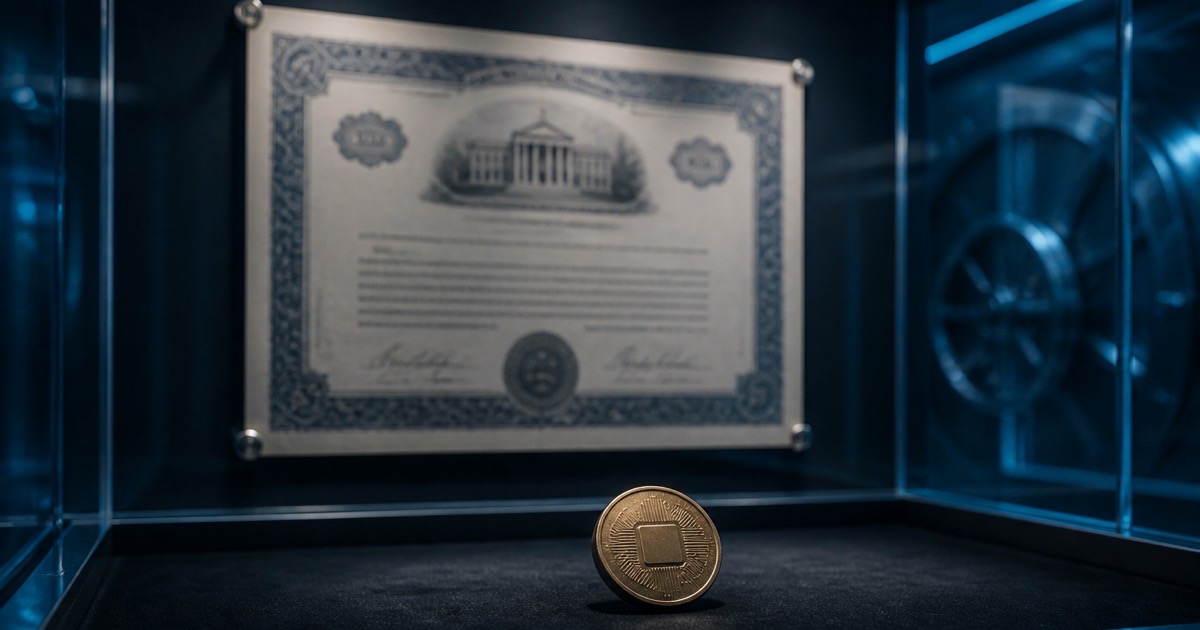
A lot of 2025 talk about blockchain in 2026 was still a forecast. A shorter list actually shipped. The United States passed a federal stablecoin statute. A major dollar-stablecoin issuer listed on the New York Stock Exchange. Tokenised Treasuries and public equities moved from slideware into live tallies you can open. The rest, including most “onchain everything” claims, is still a brochure.
This is a shipping log, not a price call. Nothing here is investment advice. Treat every token as a product with a prospectus, a venue, and a restriction list, not as a synonym for the thing it names.
A statute, not a white paper
The GENIUS Act became Public Law 119-27 on 18 July 2025. Congress.gov records the short title as Guiding and Establishing National Innovation for U.S. Stablecoins. The CRS summary is specific. Only permitted issuers may issue a payment stablecoin for use by US persons. Reserves must back the coin one-to-one with cash, Treasuries, and a short list of similarly liquid assets. Monthly reserve reports need an accounting-firm exam. Rehypothecation of reserves is barred except in narrow cases. Payment stablecoins from permitted issuers are not treated as securities or commodities under federal law, while issuers still sit under Bank Secrecy Act rules.
That is what shipped. A federal definition, a reserve rule, and a three-year clock after which digital-asset service providers may not offer coins from unpermitted issuers. a16z’s State of Crypto 2025, dated 22 October 2025, treated the Act as the US turning from hostility to a usable rulebook. The primary is still the statute. The industry report is colour.
An issuer listed
Circle Internet Group priced an upsized IPO on 4 June 2025 at $31 a share, 34 million Class A shares, ticker CRCL, with trading expected on the NYSE on 5 June and closing on 6 June. That is a corporate event, not a protocol upgrade. It still matters for blockchain in 2026 because the dollar-stablecoin market now has a listed issuer with a prospectus, not only a Twitter thread. RWA.xyz’s stablecoin dashboard on 4 September 2026 put Circle at $71.6 billion of the $304.32 billion market cap. Tether remains larger, at $181.7 billion on the same table. Two issuers dominate. That concentration shipped years ago. The listing is what is new.
a16z’s 2025 report put stablecoin supply “over $300 billion” and adjusted twelve-month volume at $9 trillion. RWA.xyz’s live cap is in the same band. Its monthly transfer volume, $7.22 trillion, is a different metric and a different window. Do not add them. Use the cap as the stock. Use a named volume series as the flow. Mixing annual adjusted volume with a monthly raw tape is how a chart lies.
Tokenised assets that you can count
a16z put the tokenised real-world asset market, Treasuries, private credit, real estate and peers, at $30 billion, up nearly four times in two years. That is the 2025 industry snapshot. It is not the same as tokenised stocks. RWA.xyz’s stocks dashboard on 4 September 2026 showed $2.77 billion of distributed value and $21.71 billion of monthly transfer volume. Ondo, bStocks, and xStocks were the three largest platforms on that table. The sliver is the fact. Equity tokens are live. They are not the stablecoin market.
The earlier Current Ventures explainer on real-world asset tokenisation was about an addressable claim. This page is about what a public tracker shows now. Those are different jobs. Fintech disruption in 2026 is the wider map. Keep the shipping log narrower.
Infrastructure that is boring on purpose
a16z’s 2025 infrastructure chapter is the one claim that matches the harbour photo. Aggregate throughput across major networks, in their telling, rose more than 100 times in five years, to about 3,400 transactions per second. Average costs on Ethereum layer-2s fell from around $24 in 2021 to less than one cent. Those figures are the industry report’s, not a lab benchmark you can paste into a board pack without opening the PDF. What shipped for a user is cheaper blockspace and more listed products on the rails they already have. What did not ship is a single global exchange for every asset.
Bridges, layer-2s, and custody remain the unglamorous work. A container that moves is a crane, a clerk, and a stamp. A token that moves is a chain, a custodian, and a restriction list. The photo is the metaphor. It is also the warning. If you cannot name the clerk, you do not have a shipment.
What still has not shipped
Weekend cash-equity hours on every venue. Unrestricted US retail access to tokenised US stocks. A world in which “tokenised Apple” means you hold the share, vote, and receive the dividend as a shareholder of record. Kraken’s own xStocks page is explicit that the tokens do not confer ownership or voting rights. That product is the next article. The point here is simpler. A ticker that looks like a stock is not the stock until the prospectus says so.
Memecoins, perps, and prediction markets did plenty of volume in a16z’s 2025 tape. Volume is not the same as a statute, a listing, or a reserve report. Blockchain in 2026 earned those three. It did not earn a rewrite of every capital-markets rule.
What actually shipped is a US payment-stablecoin law, a listed dollar-stablecoin issuer, a $300 billion-scale stablecoin cap on a public tracker, and a much smaller live book of tokenised stocks. Plan from those four. Discount the rest until it has a docket number, a ticker, or a dashboard you can reload.
Key takeaways
- The GENIUS Act became US law on 18 July 2025. Permitted issuers, one-to-one reserves, monthly examined reports.
- Circle priced its IPO on 4 June 2025. CRCL was expected to trade on the NYSE the next day.
- RWA.xyz on 4 September 2026: $304.32 billion stablecoin cap, $2.77 billion tokenised-stock distributed value.
- a16z’s 2025 report put tokenised RWAs at about $30 billion. That is a broader basket than stocks.
- A token that shares a ticker with a share is still a product. Read the prospectus before you treat it as the share.
FAQ
What actually shipped for blockchain in 2026?
A US payment-stablecoin statute, a listed dollar-stablecoin issuer, a $300 billion-scale stablecoin market on public trackers, and a much smaller live book of tokenised stocks. Most other claims are still forecasts.
Did the GENIUS Act legalise all crypto?
No. It sets rules for payment stablecoins issued to US persons: permitted issuers, one-to-one reserves, and reports. It does not rewrite securities law for every token.
Is the tokenised stock market as large as stablecoins?
No. RWA.xyz on 4 September 2026 showed $2.77 billion of distributed value in tokenised stocks against $304.32 billion of stablecoin market cap.
Should I treat a16z volume figures as the same as RWA.xyz?
No. a16z published 2025 annual and adjusted series. RWA.xyz publishes live dashboards with different windows. Name the series. Do not add them.
Is this investment advice?
No. It is a shipping log. Tokens are products with prospectuses and geo-limits. Take independent advice before you buy anything.
Sources
- US Congress, S.1582, GENIUS Act, Public Law 119-27, 18 July 2025. congress.gov/bill/119th-congress/senate-bill/1582
- Circle Internet Group, “Circle Announces Pricing of Upsized Initial Public Offering”, 4 June 2025. investor.circle.com/…/Circle-Announces-Pricing-of-Upsized-Initial-Public-Offering
- RWA.xyz, Stablecoins dashboard, retrieved 4 September 2026. app.rwa.xyz/stablecoins
- RWA.xyz, Tokenized Stocks dashboard, retrieved 4 September 2026. app.rwa.xyz/stocks
- a16z crypto, “State of Crypto 2025: The year crypto went mainstream”, 22 October 2025. a16zcrypto.com/…/state-of-crypto-report-2025
- Kraken, “Tokenized Stocks and ETFs on Kraken”. kraken.com/xstocks
This article is general information, not investment advice. See section 4 of our Terms & Conditions.
This is the kind of decision we advise on. If you are weighing it for your own business, see how we work or start a conversation.